
Galleries and Translations > Recent Works / Poetry and Others > A Tale of the Peach Blossom Spring《 桃花源記 》
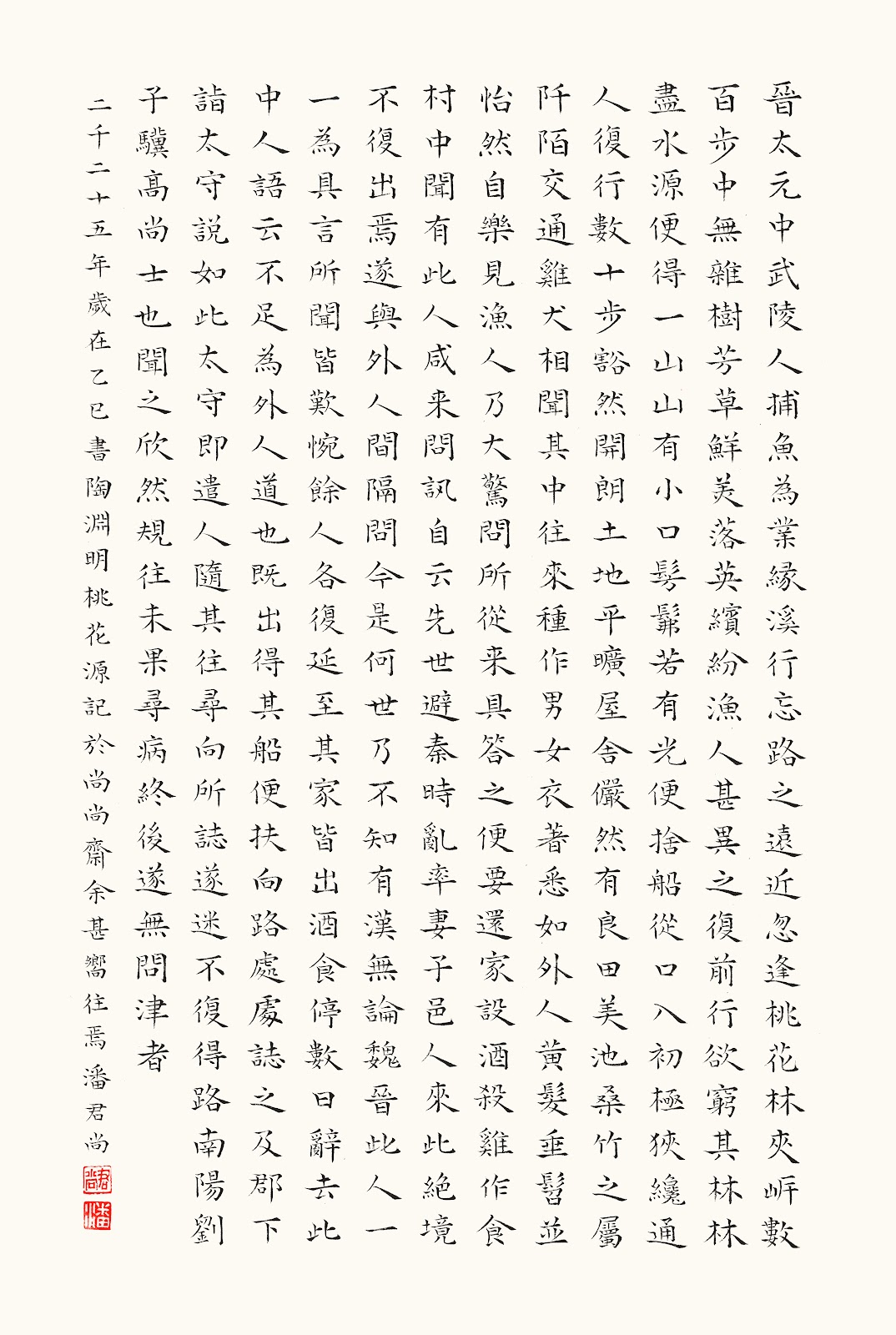
(《 桃花源記 》)
90 X 60cm in Standard Script (楷書)
Translation
(Translated by Xianyi Yang (楊憲益) and Gladys Yang (戴乃迭) (1) with revisions by KS Vincent Poon. Revisions are indicated by the underlined texts.)
Original Chinese
English Translation
1. 晉太元中, 武陵人, 捕魚為業.
In the Taiyuan period of the Jin Dynasty, there was a man of Wuling who was a fisherman by trade.
2. 緣溪行, 忘路之遠近, 忽逢桃花林.
One day, he was fishing up a stream in his boat, and heedless of how far he had gone, when suddenly he came upon a forest of peach trees.
3. 夾岸數百步, 中無雜樹.
On both banks for several hundred steps (Yang: yards), there were no other kinds of trees.
4. 芳草鮮美, 落英繽紛.
The fragrant grass was delicious and beautiful to look at, all patterned with fallen blossom.
5. 漁人甚異之, 復前行, 欲窮其林.
The fisherman was extremely surprised and went on further, determined to get to the end of this wood.
6. 林盡水源, 便得一山, 山有小口, 彷彿若有光.
He found the end of the wood and the source of the stream together, at the foot of a cliff, and in this cliff, there was a small cave in which there seemed to be a faint light.
7. 便捨船, 從口入.
He left his boat and went in through the mouth of the cave.
8. 初極狹, 纔通人, 復行數十步, 豁然開朗.
At first, it was very narrow, only just wide enough for a man, but after several ten steps (Yang: forty or fifty yards), he suddenly found himself in the open.
9. 土地平曠.
The place he had come to was level and spacious.
10. 屋舍儼然, 有良田、美池、桑竹之屬.
There were houses (Yang: houses and cottages) arranged in a planned order; there were fine fields and beautiful pools; there were mulberry trees, bamboo groves, and many other kinds of trees as well.
11. 阡陌交通, 雞犬相聞.
There were raised pathways round the fields, and he heard the sound of chickens and of dogs.
12. 其中往來種作, 男女衣著, 悉如外人, 黃髮垂髫, 並怡然自樂.
Going to and fro in all this, and busied in working and planting, were people, both men and women. Their dress was not unlike that of people outside, but all of them, whether old people with white hair or children with their hair tied in a knot, all were happy and content with themselves.
13. 見漁人, 乃大驚, 問所從來, 具答之.
When they saw the fisherman, they were greatly shocked (Yang: amazed) and asked him where he had come from. He answered all their questions.
14. 便要還家, 爲設酒殺鷄作食.
And then they asked him back to their home (Yang: homes), where they put wine before him, killed chickens and prepared food in his honour.
15. 村中聞有此人, 咸來問訊.
When the other people in the village heard about the visitor, they too all came to inquire (Yang: ask questions).
16. 自云先世避秦時亂, 率妻子邑人來此絶境, 不復出焉, 遂與外人間隔.
They themselves told him that their ancestors had escaped from the wars and confusion in the time of the Qin Dynasty. Bringing their wives and children, all the people of their hometown (Yang: district) had reached this inaccessible place, and never again had they left it. Thus, they had lost all contact with the world outside.
17. 問今是何世,乃不知有漢,無論魏晉.
They asked what dynasty it was now. They had never even heard of the Han, let alone the Wei and the Jin.
18. 此人一一爲具言所聞,皆歎惋.
Point by point, the fisherman explained all he could of the world that he knew, and they all sighed in deep sorrow.
19. 餘人各復延至其家,皆出酒食.
Afterwards, all the rest began again to ask him to their homes, and all feasted him with wine and food.
20. 停數日,辭去. 此中人語云:「不足爲外人道也.」
He stayed there several days and then bade them goodbye; but before he departed, these people said to him: "It is not necessary to (Yang: Never) speak to anyone outside about this!"
21. 既出,得其船,便扶向路,處處誌之. 及郡下,詣太守,説如此.
So he went out, found his boat and went back by the same route as he had come; but all along the way he left marks; and when he got to the provincial capital (Yang: town) he paid a visit to (Yang: called on) the prefect and told him all about his experience.
22. 太守即遣人隨其往,尋向所誌,遂迷,不復得路.
The prefect at once sent men to go with him and follow up the marks he had left. But they became completely lost (Yang: confused over the marks) and never succeeded in finding the way again (Yang: the way).
23. 南陽劉子驥,高尚士也. 聞之,欣然規往. 未果,尋病終. 後遂無問津者.
A scholar from Nanyang, a man of high character (Yang: reputation) named Liu Ziji, heard of the affair and enthusiastically planned to find the place (Yang: offered to go out with the fisherman to try again). However, that did not come to fruition (Yang: But this, too, came to nothing), for he fell ill and died. After that, no one bothered to investigate and search for it. (Yang: went any more to look for the stream).
Remarks
(I)
Around 421 AD, Jin's Tao Yuanming (陶淵明, 365–427 AD) composed A Tale of the Peach Blossom Spring (桃花源記), which has since become a must-read classic in Chinese literature (2,3). Due to its widespread recognition, various renowned calligraphers had scribed its full text, including Zhang Ruitu (張瑞圖, 1570-1641 AD) (4) and Zhu Da (朱耷, 1626-1705 AD) (5) of the Ming Dynasty.
(II)
The most appealing aspect of the tale is Yuanming's description of the Peach Blossom Springs (桃花源): a small, quiet community completely isolated from the outside world, where people can live peacefully by their own nature. Such resembles the utopia cherished by Laozi (老子, 571 – 470 BC):
“小國寡民…甘其食, 美其服; 安其居, 樂其俗… 鄰國相望, 雞犬之聲相聞. 民至老死, 不相往來.”"An ideal state is small, with very few (寡) people living in it… The people enjoy (甘) their primitive food and cherish (美) their plain clothes; they are content (安) with their simple dwellings and are happy with their native habits and customs (俗). Neighbouring states observe (望) each other, and the cries of fowls and dogs among the neighbouring states can also be heard. Yet, till their deaths (老死), people from different states shall have no contact (往來) with each other." (6)
(III)
Historically, many Chinese intellectuals of high character dream of living in the Peach Blossom Spring rather than seeking public office and recognition, because serving in any Chinese regime while standing firm in one's moral principles is quite hazardous. Regrettably, however, most die before fulfilling those dreams, a fate they can rarely overcome.
KS Vincent Poon, January 2026
_______________
(1) Xianyi Yang & Gladys Yang, Poetry and Prose of the Han, Wei and Six Dynasties. Beijing: Panda Books, 1986, pp. 63-65.
(2) 龔斌,《陶淵明集校箋》. Shanghai: 上海古籍出版社, 1999, p.405.
(3) 梁啟超,《陶淵明》. Shanghai: 商務印書館, 1947, p.25.
(4) 劉正成, 《中國書法全集》, Vol.55, 張瑞圖. Beijing, 榮寶齋出版社, 1992, p.38.
(5) 《朱耷行草書桃花源記卷》. 作品今藏北京故宮博物院.
Jump to: Poetry and Others
Jump to: Works in Standard Script