
Galleries and Translations > Recent Works / Models of Masterpieces > A Model of the Yellow Court Classic (臨《黃庭經》)
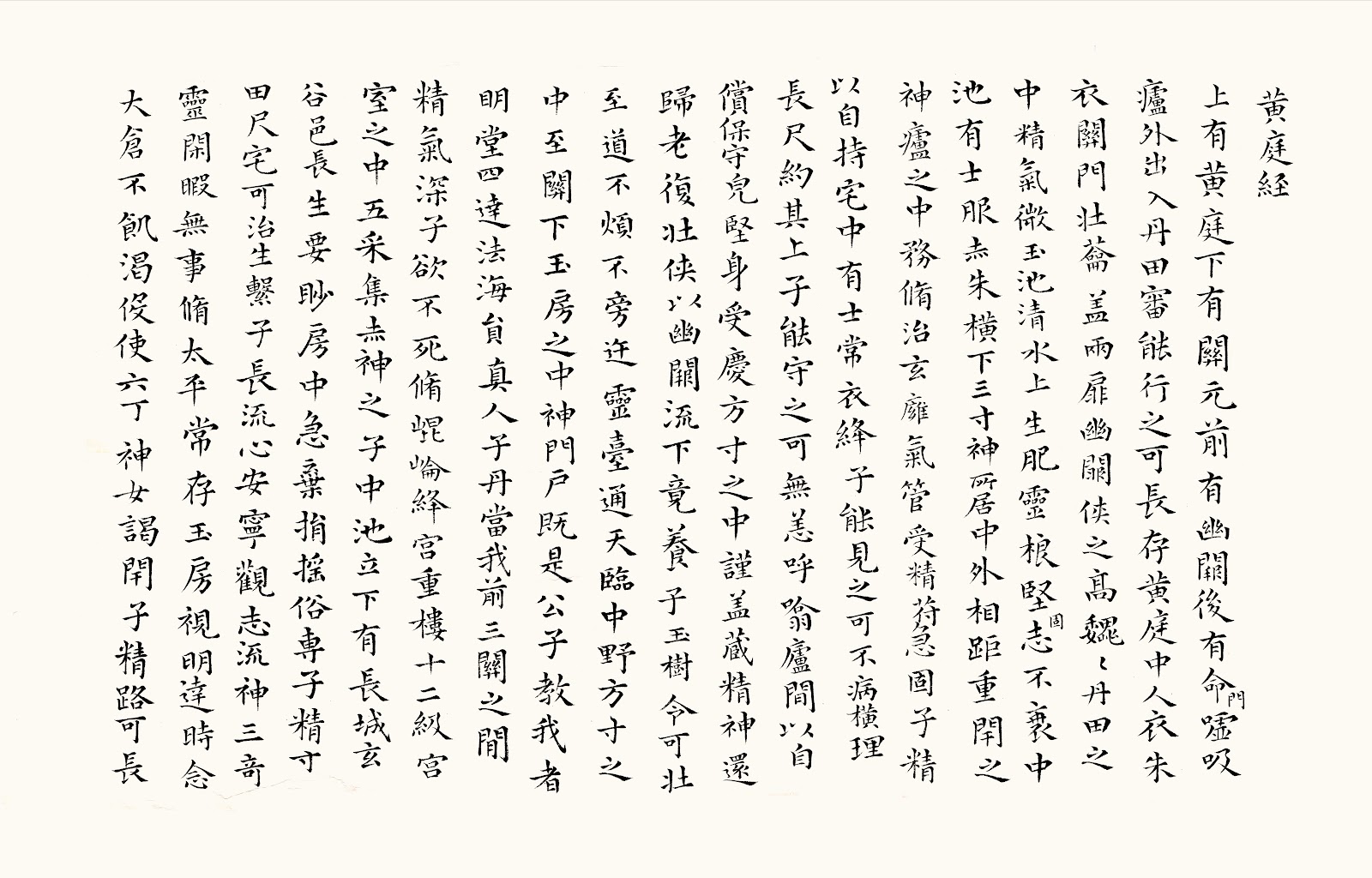
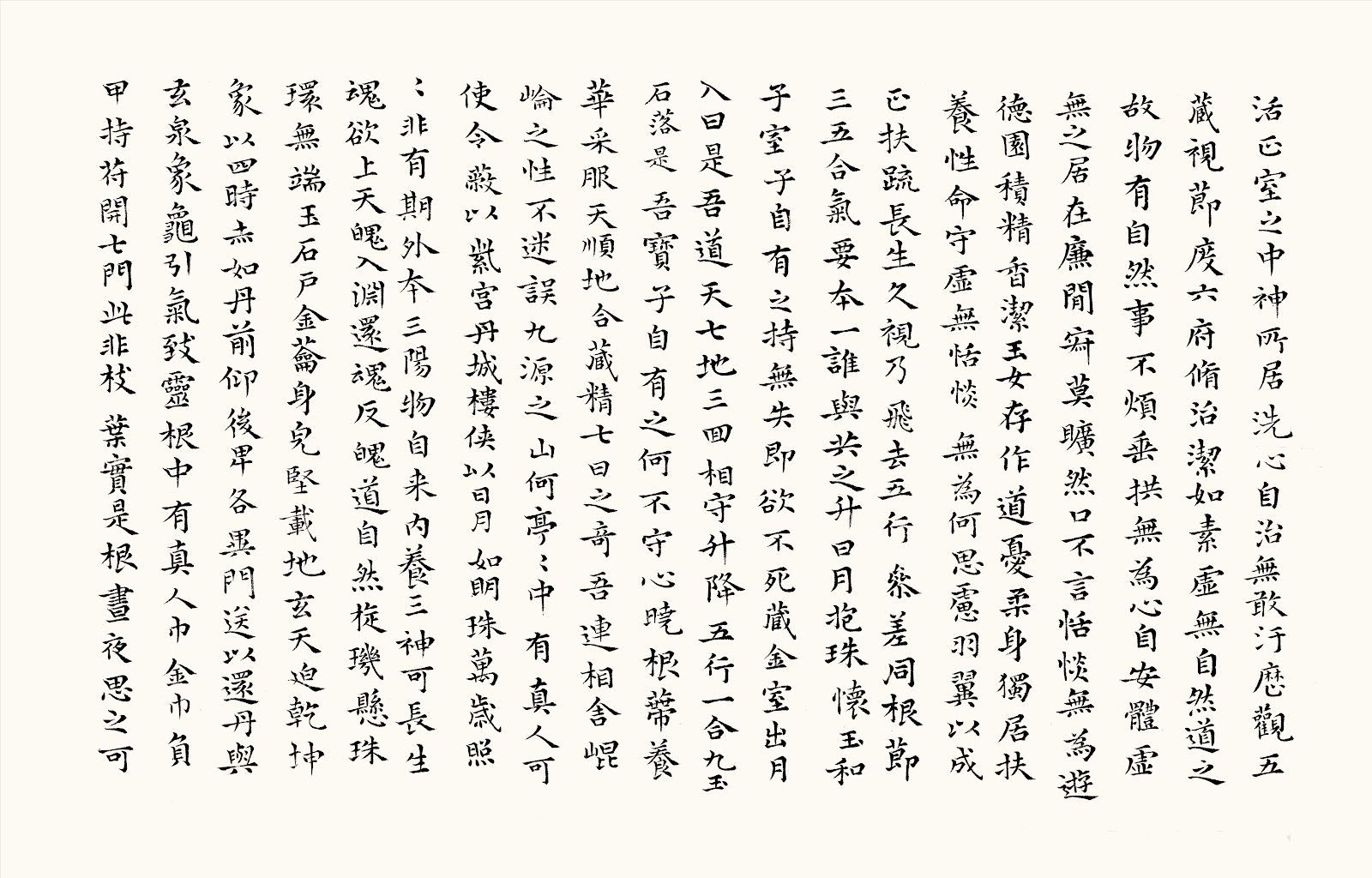
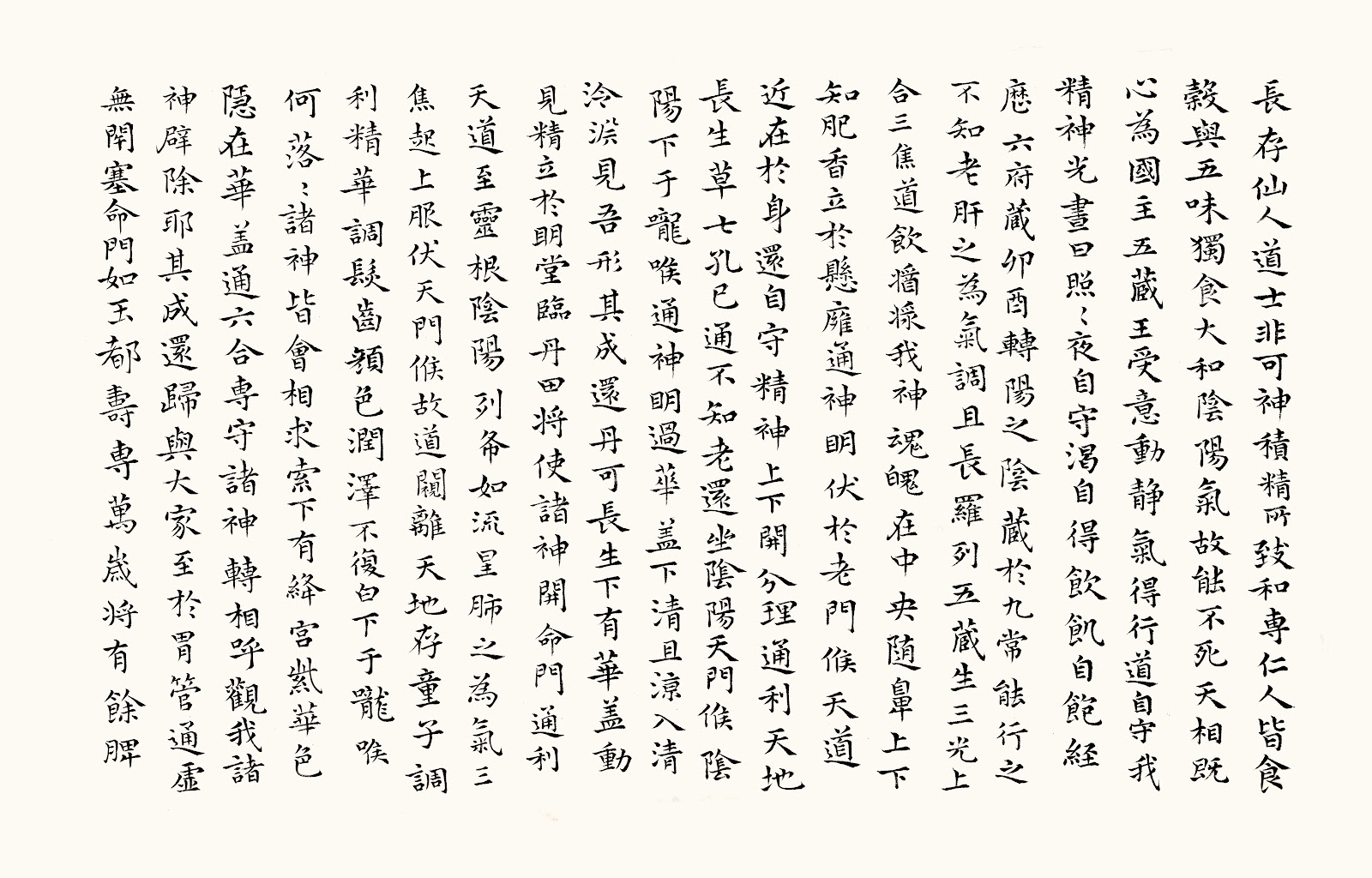

A Model of the Yellow Court Classic (臨 《黃庭經》)
70 X 110cm (4)
Click to Enlarge. In Reserve, not available in Shop.
A Model of The Yellow Court Classic (臨《黃庭經》)
70 X 110cm (4) in Standard Script (楷書)
Remarks
(I)
The Yellow Court Classic (黃庭經) is a canon of the Taoist religion (道教), composed by unverifiable authors during the Han Dynasty (202 BC-220 AD) (1). It is divided into two sections, the Neijing (內景) and the Waijing (外景) (2). In 356 AD, Wang Xizhi (王羲之, 303-361 AD), one of the best Chinese calligraphers of all time, scribed the entire text of the Waijing (外景) in standard script (3). This work has since been widely recognised as a Classical Chinese Calligraphy Masterpiece (法書)(4). My work above is based on a model of Wang's original, which is housed at Taiwan's National Palace Museum (5).
(II)
Wang's wonderful calligraphy in the Yellow Court Classic has been admired by many. Tang Dynasty's Sun Guoting (孫過庭, 646-691 AD) praised it as "joyful and in a state of nothingness (怡懌虛無)"(6), while Qing Dynasty's Liang Yan (梁巘, 1710-1788 AD) believed "Wang's Yellow Court had reached the pinnacle, and no subsequent calligrapher was able to surpass it (《黃庭》已登絕境,任後之窮書能事者,皆未能過)"(7).
(III)
Although the Yellow Court Classic (黃庭經) is an important scripture of the Taoist religion (道教), its theme runs counter to the original Taoism (道家) established by Laozi (老子). The Yellow Court Classic directs one to become an immortal celestial being (成仙不死) (8) through rigorous refinement and cultivation of the mind and body (修煉) (9). However, according to Laozi's Tao Te Ching, humans cannot last forever, no matter how hard they try:
“飄風不終朝, 驟雨不終日。孰為此者? 天地。天地尚不能久, 而況於人乎!”"Sounds from violent winds (飄風) do not last for a whole morning (朝), and noises from sudden torrential rains (驟雨) do not last for an entire day. What directs all these? The Universe. Even the Universe cannot make its own act last forever, let alone (況於) mere humans!" (10)
Laozi taught that only the Immutable (常) (11) Tao lasts forever (道乃久) (12), while everything else has an end and eventually returns to Tao, the root of all things (13). Moreover, any action to counter this inevitable return is not only futile but also hazardous:
“歸根曰靜, 是謂復命。復命曰常, 知常曰明。不知常, 妄作凶。”"Returning to the root is known as being Tranquil (靜), which is otherwise known as returning (復) to the Natural Destiny (命). Returning to the Natural Destiny is known as adhering to the Immutable (常). Understanding this Immutable is known as Enlightenment (明). If one does not know nor understand this Immutable and acts rashly (妄作) without due consideration, then one shall face ominous outcomes (凶)." (14)
Laozi further warned that such ominous outcomes include an early demise:
"不道早已!""Whatever that is not following Tao will come to its end (已) very soon (早)!" (15)
Laozi never instructed one to become an immortal being. He merely espoused that one should follow Tao, the fundamental way of the Universe, to avoid harm and preserve one's natural lifespan (16). Accordingly, any concept of seeking immortality that is purportedly by Laozi is either fabricated or fictitious.
KS Vincent Poon, December 2025
_______________
(1) 蕭登福,《黃庭經古注今譯》. Hong Kong: 青松出版社, 2017, pp.3-8.
(2) Ibid.
(3) 劉正成,《中國書法鑒賞大辭典》. Beijing: 大地出版社, 1989, p.165.
(4) Ibid.
(5) 《晉王羲之黃庭經》. 帖今藏國立故宮博物院.
(7) As in footnote (3).
(8) As in footnote (1), pp.16 and 52.
(9) As in footnote (8).
(11) Ibid., p.15.
(12) Ibid., p.26.
(13) Ibid..
(14) Ibid..
(15) Ibid., p.54.
(16) Ibid. p.54 and 67.